The Case for the Quiet Province: What a Small Resort in Nan Says About Where Asian Travel Goes Next

Named Asia’s Finest Mountain Resort at the 2026 Asia Hospitality Awards, Sataa Resort Nan is small, dark-timbered and deliberately remote. Its real achievement is an idea: that in an over-touristed region, the most valuable thing a resort can offer is somewhere quiet - and the design discipline to leave it that way.
The most telling detail at Sataa Resort Nan is a window that refuses to show you everything. In the resort’s teak-forest wing, the openings are elliptical, curved and sparing cut not to flood a room with view but to isolate a single trunk and the canopy above it, so that a guest sees one tree properly rather than a whole valley vaguely. It is a small decision with a large argument inside it. In a hospitality market trained to sell the widest possible panorama, Sataa’s architects chose to frame less.
That instinct - to withhold, to slow the eye, to let a place arrive gradually - runs through the whole resort, and it is why the property matters beyond its own 26 rooms. Sataa sits in Phu Phiang, on the edge of Nan, one of the least-visited provinces in northern Thailand: a former principality of rice terraces, teak stands and river valleys that most itineraries skip on the way to somewhere louder. In June 2026, the Asia Awards Organization named Sataa Resort Nan the winner of Asia’s Finest Mountain Resort at the 2026 Asia Hospitality Awards (AHA). The award is a category title, not a verdict on taste. The more interesting claim the resort makes is strategic: that remoteness, designed for rather than apologised for, is now a product - and a template for where Asian travel could sensibly go next.
Context
Sataa Resort Nan opened as a boutique property in Phu Phiang District, Nan Province, developed by Satha Hospitality Co., Ltd. It comprises 26 guest rooms and a single pool villa across a site of roughly ten-plus acres, arranged as low, two-storey timber blocks rather than a single massed building. The architecture and interiors are by Studio Miti, a Bangkok practice with nearly fifteen years of work in climate-responsive Thai design; the landscape is by Choop-Choo-Jai Landscape Design, with Sanit Project as design consultant. The 2026 Asia Hospitality Awards - organized by the Asia Awards Organization - placed Sataa in its Resort discipline as Asia’s Finest Mountain Resort.
Nan is an unusual place to build a resort, and that is the point. The province has been the subject of academic scenario-planning as a candidate “low-carbon tourism city”, precisely because its heritage - temple murals, riverine agriculture, timber craft - is both a draw and something tourism could erode if it arrived at scale. Nan’s identity is quietness; the risk to Nan is that quietness sells. A resort here therefore inherits a question that coastal Thailand answered badly a generation ago: how do you invite visitors to a fragile place without turning it into the thing they came to escape?

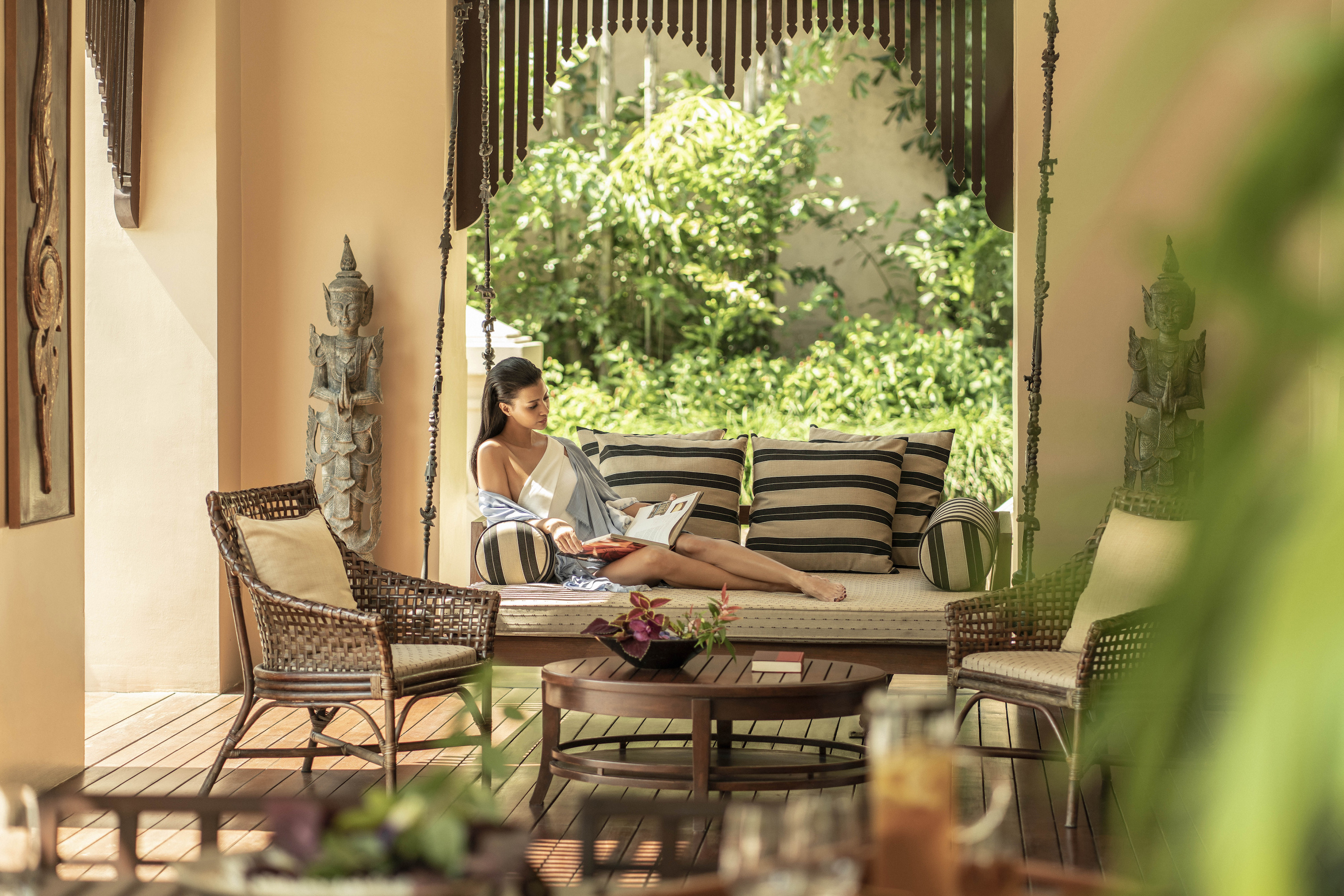
Sataa’s answer begins with restraint as a design language, not a marketing word. The resort takes its cue from the Lanna north’s “Baan Dam”, or black-house, tradition: dark-stained teak, deep shadow, small openings. Studio Miti kept the existing teak and tamarind trees on the site and built around them, and it limited window sizes in a way that reads first as atmosphere - dim, cool, contemplative interiors - but works second as passive climate control, reducing heat gain in a warm, humid region. The dark timber is not a mood board; it references the north’s own tradition of preserving wood, and it lets the buildings recede rather than announce themselves against the rice fields. Where most resorts compete by adding - bigger glass, brighter pools, more spectacle - Sataa competes by subtracting, and by making the subtraction legible.

The second layer is the argument the design is really making: that geographic dispersal is the mature answer to Asia’s tourism concentration. Thailand’s visitor economy has long been lopsided toward a handful of destinations, and the strain on Bangkok, Phuket and Chiang Mai - on their water, their streets, their housing - is well documented. A property that persuades travellers to spend a week in Nan instead is not just a nice boutique story; it is a small transfer of demand from places that have too much of it to a place that could use a little, on terms it can control. Sataa’s zoning makes this concrete. Its rooms are organised by what they look onto - a rice-field wing whose ground-floor rooms sit at soil level and whose upper rooms step up to a wider view, and the teak-forest wing with its framed trunks - so that the destination itself, not the resort’s amenities, is the thing being sold. The building is a lens for Nan, not a substitute for it.

A sceptic should push here, and the piece is better for letting them. The obvious objection is that a design resort is exactly how a quiet province stops being quiet: today one restrained 26-room property, tomorrow the access road, the imitators, the coach tours, the slow hollowing of the thing that made Nan worth the trip. That risk is real, and one resort winning one award does not disprove it. Nor has Sataa published the occupancy, spending or environmental-performance data that would let anyone verify that its presence is net-positive for Phu Phiang. The honest defence is narrower and more durable: at 26 rooms, Sataa is built at a scale that cannot become mass tourism by itself, and its design choices - keep the trees, shrink the footprint’s visual weight, point guests at the province - are the choices that a developer chasing volume would not make. The award recognises a direction of travel, not an audited outcome. What Sataa demonstrates is that the restrained version is buildable and marketable - which is the precondition for it to spread.

The third layer is why that version is hard to copy, and therefore defensible. Sataa’s interiors are stitched with specifically local reference: structural patterns drawn from regional timber joinery, floor graphics adapted from the water-flow motifs of Nan’s own silk-weaving heritage, a swimming pool whose meandering shape echoes the Mae Nan river and its watershed. None of this is available off a procurement catalogue. It requires knowing Nan, working with the craft traditions that are still alive there, and - in Sataa’s case - collaborating with the neighbouring Wat Chae Phlang monastery and surrounding farming communities to root the resort in its setting. A competitor can copy dark timber and small windows. It cannot copy a relationship with a place. That is the moat: the resort is not decorated like Nan, it is made of Nan, and that authenticity is the part a generic international operator cannot parachute in.

There is a commercial logic beneath the restraint, and it deserves to be named rather than romanticized. A 26-room resort is not a compromise forced by a small site; it is a business model. Volume hospitality earns by filling rooms and discounting to do it; a property this size earns by being specific enough that its guests do not price-compare it against anything, because there is nothing quite like it to compare against. Smallness caps the downside - Sataa cannot flood Nan with visitors even if it wanted to - while identity protects the upside, letting the resort hold rate on the strength of what it is rather than what it costs. That alignment, where the responsible choice and the profitable choice point the same way, is the quiet reason a dispersal model might actually spread: it does not ask an operator to trade margin for virtue. It is worth being clear that this remains a proposition rather than a proven ledger - Sataa has published no yield or occupancy figures - but the structure of the bet is coherent, and coherence is what persuades the next developer.
The people behind it
Studio Miti was founded in 2010 by two architects, Prakit Kanha and Padirmkiat Sukkan, who met at architecture school and built a practice around a conviction that Thai buildings should be designed from their climate outward. “We use pure materials in their original visual shape, colour and texture without over-embellishments”, Sukkan told the design publication Living ASEAN, describing an approach that treats teak, brick and stone as finished things rather than surfaces to be dressed. On designing for the tropics, he is blunt about the fundamentals: architects “must have a good understanding of sunlight, the heat, humidity and the cold. They are the basics”. That philosophy is visible across the studio’s catalogue - the brick-and-timber Athita hotels in the north, the ventilation-first Baan Yoo Yen residence - and it is the through-line at Sataa, where climate logic and cultural reference are the same set of decisions rather than competing ones.
The commissioning side matters too. Satha Hospitality’s decision to place an ambitious, design-led property in Phu Phiang - rather than on a beach with guaranteed footfall - is a bet on a destination rather than on a formula. It is the kind of patient, place-specific capital that secondary provinces rarely attract, and its presence is arguably as significant as the architecture. What can be said from the public record is that the resort was conceived to benefit its surroundings as well as its guests, through its monastery and community partnerships - a framing the owners have chosen to foreground.
Impact - two tiers
The impact works on two levels. For the industry and the region, Sataa is a usable proof-of-concept for dispersal. Asia’s tourism debate has been dominated by how to manage crowds in the places that already have them; the more hopeful move is to make the quiet places genuinely desirable, so that demand redistributes on its own. A design resort that wins a regional award while sitting in a low-carbon-minded province gives operators, provincial authorities and investors a reference point: this is what the restrained, dispersed version looks like, and it is credible enough to be honored. If the model travels - to other Thai secondary provinces, to the highlands of Vietnam and the wider region’s interiors that mass tourism has skipped - the benefit is a broader tourism map and a lighter load on the coasts.
For the resort’s own guests and owner, the value is more immediate. Guests receive something the crowded destinations can no longer reliably sell: quiet, specificity, and the sense of having been somewhere particular rather than somewhere processed. The framed teak, the soil-level rice-field room, the river-shaped pool are not luxuries of excess but of attention. For the owner, that translates into a defensible market position - a property that competes on identity rather than on price or on a formula any chain can replicate - and, potentially, resilience against the seasonal and shock-driven swings that punish single-note destinations. Provenance, in a resort as in a wine, is the part that cannot be discounted.

Closing
The elliptical window that frames a single teak tree turns out to be the whole thesis in miniature. Sataa Resort Nan is not important because it is large, or lavish, or first; it is important because it argues, convincingly and at a buildable scale, that the future premium in Asian hospitality may lie in restraint - in choosing the quiet province, designing to keep it quiet, and selling the place rather than the resort. Its recognition as Asia’s Finest Mountain Resort at the 2026 Asia Hospitality Awards places that argument on the record.
It is an argument the region will keep making. In 2027 the Asia Hospitality Awards will convene in Bangkok for its next season, where the properties defining Asia’s next decade of travel will be recognized. Hotels and resorts whose work speaks this same language of intent - of place held lightly and made precisely - belong in that conversation, and can follow it at ahawards.co.
Photo Credit: Sataa Resort Nan